Introduction: The Flame of Revival
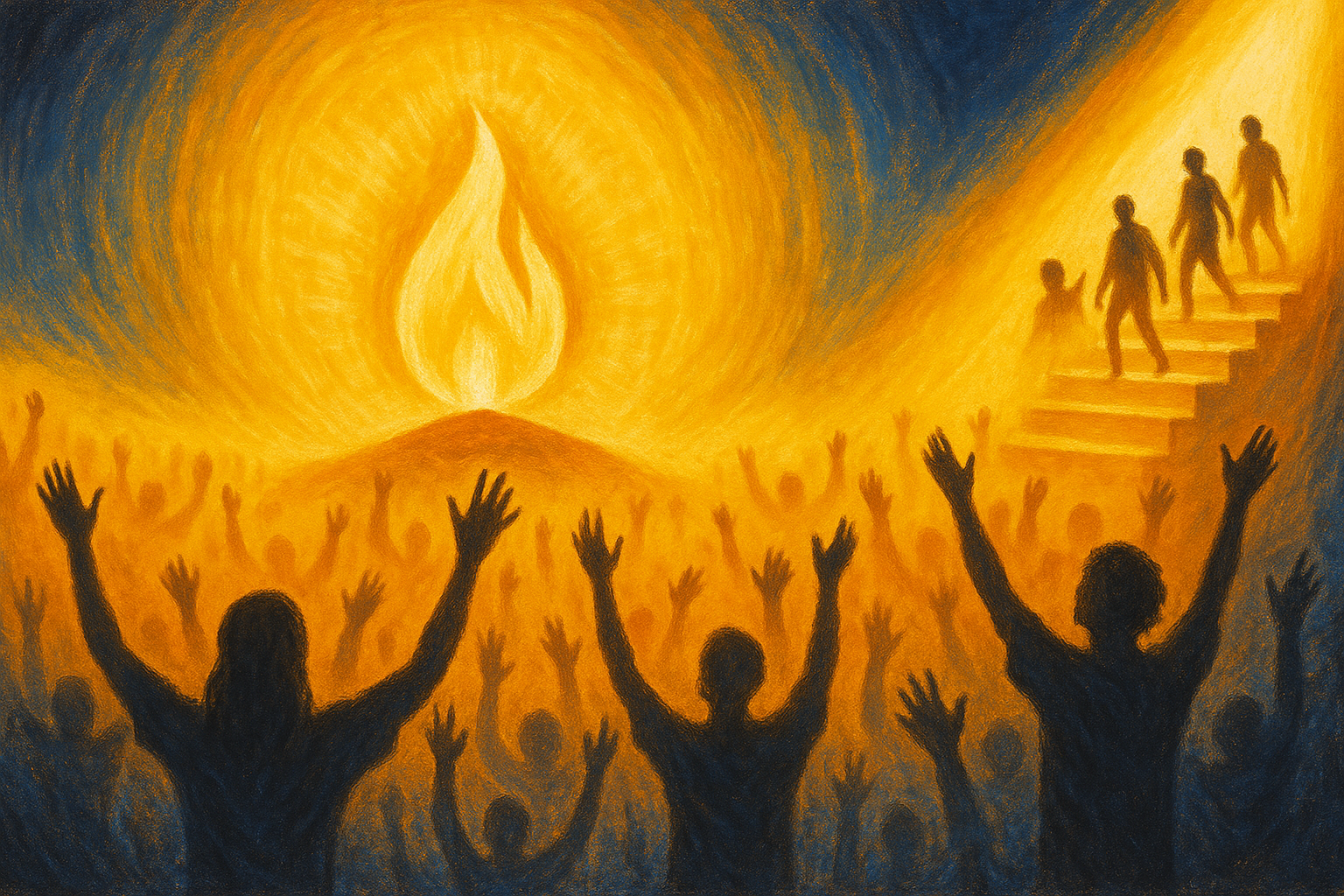
Josiah's flame is possible. That's the heart of Zephaniah's message.1 You cannot understand Zephaniah without understanding Josiah. Through Zephaniah's prophecy, Josiah's flame blazed forth—revival was possible, the fire could burn again.
No matter how dire the situation, no matter how deep the disobedience, God is always present.1 When the remnant encountered the God who dwells among them through worship, the flame ignited.
John Piper defined missions as "bringing worship where worship is not."1 Worship is encountering the God who dwells among us—it's when the flame ignites in the hearts of the remnant. Without worship, nothing happens. Revival comes, life comes, only when worship is present.
First Point: The Worshippers' Response - Joy That Springs from Being
The Command to Rejoice (Zephaniah 3:14-16)
Let's read together Zephaniah 3:14-16:
"Sing, Daughter Zion; shout aloud, Israel! Be glad and rejoice with all your heart, Daughter Jerusalem! The Lord has taken away your punishment, he has turned back your enemy. The Lord, the King of Israel, is with you; never again will you fear any harm. On that day they will say to Jerusalem, 'Do not fear, Zion; do not let your hands hang limp.'"2
Notice this isn't joy based on mere circumstances.1 Yes, punishment is removed and enemies are turned back, but the deeper reason for joy is because the Lord is with you, because He dwells among you, because of His presence. This joy flows from a transformed identity—from being God's children, God's people.
Being Leads to Doing
Here's the fundamental principle: Being leads to Doing.1 Our existence, our identity, determines our actions. We must always start by confirming our being—once that's established, everything else follows naturally.
Let me illustrate with a simple example. You know that friend who always suggests steakhouses when you go out to eat? You can predict it, right? And that other friend who always picks seafood restaurants? Why? Because that's who they are—their being determines their choices.1
A lion loves meat because it's a lion. A cow eats grass because it's a cow. God's creative hand is reflected in our preferences and nature.1
The Gospel of Being
This applies spiritually too. We don't sin and then become sinners—we sin because we ARE sinners.1 But praise God, the same principle applies to salvation. We don't do good works to become saved; we do good works because we ARE saved.
2 Corinthians 5:17 reminds us: "Therefore, if anyone is in Christ, the new creation has come: The old has gone, the new is here!"1 What does it mean to be a new creation? It means our very being has been transformed. Worship is the time when our existence is changed, when we receive the authority to become children of God.
Jesus' Teaching on Being vs. Doing
Remember in Luke 10 when the seventy disciples returned from their mission, excited that "even the demons submit to us"? Jesus responded with something more important: "Do not rejoice that the spirits submit to you, but rejoice that your names are written in heaven."1
Demons submitting is about doing—your names written in heaven is about being. Jesus was teaching that our identity transformation is far more significant than our actions.
Isaiah's Transformation
Consider Isaiah's temple experience. When he saw God's glory, he cried, "Woe to me! I am ruined!" But after the seraph touched his lips and declared his guilt taken away, his sin atoned for, THEN came the response: "Here am I. Send me!"1 The being was transformed first, then the doing followed.
Second Point: Reversal and Victory for the Marginalized
God's Heart for the Marginalized (Zephaniah 3:18-20)
Look at who God specifically mentions in verses 18-20:
- Those who grieve over the appointed festivals (those who can't worship)1
- The lame (those who can't compete)1
- The exiles (those who've lost their foundation)1
These are what sociologists call "marginal people"—those on the periphery, the underdogs, the overlooked.1
The Marginal Advantage
Here's something fascinating about history: it's often the marginalized who drive change. In Europe, the established powers like France and England were comfortable with the status quo. But Spain and Portugal, on the periphery, facing blocked trade routes, asked "Why is the world like this?" Their desperation drove them to explore the Atlantic and discover the New World.1
The Irish potato famine of the 19th century forced massive immigration to America. Those who stayed comfortable in England remained, but those who asked "Why is the world like this?" became a major force in American society.1
God's Upside-Down Kingdom
1 Corinthians 1:27 tells us God's pattern: "God chose the foolish things of the world to shame the wise; God chose the weak things of the world to shame the strong."1 This is God's reversal principle.
Usually, God gives worship power to the weak, the lacking, the marginalized. Well-fed people don't come to worship easily. For a rich or powerful person to truly worship in spirit and truth—that's miraculous.1
The Promise of Honor and Praise
God promises these marginalized people "praise and honor" (v. 19). The Hebrew word for "praise" is actually the word used for praising God—it's as if God is saying He'll make them God-like in their being.1 "Honor" means He'll lift up their name with divine-like power. This is reversal—complete transformation.
Third Point: God's Response - Divine Joy Over His People
The Remarkable Description (Zephaniah 3:17)
This verse is extraordinary in Scripture because it shows us God's emotional response:
"The Lord your God is with you, the Mighty Warrior who saves. He will take great delight in you; in his love he will no longer rebuke you, but will rejoice over you with singing."2
God's Uncontainable Joy
The text says God "will take great delight in you"—literally, God cannot contain His joy when He looks at worshipping people.1 Just imagine—God looking at you and being overcome with joy!
They say three things cannot be hidden: love, poverty, and a cold. But especially love—when someone loves you, it shows. Their eyes light up, they can't help but smile. That's how God loves us—His love for us is so obvious it can't be concealed.1
God as Mighty Warrior
God is not just present—He's a "Mighty Warrior who saves." He's not passive in His love; He actively fights for our salvation and deliverance.2
God's Quiet Love and Joyful Song
The verse says He "will quiet you with his love" and "rejoice over you with singing."1 Sometimes God's love is quiet and deep, sometimes it bursts forth in joyful song. But it's always there, always active.
Application and Conclusion
Establishing Our Identity as Worshippers
Church, we need to rejoice as God's children, as the redeemed, as worshippers.1 This isn't forced joy—it's natural joy that flows from who we are. When worship is real, joy just happens naturally.
Avoiding Legalism Through Being-Focus
To avoid legalism and works-righteousness, we must always start with being.1 Approaching faith through doing is missing the point. Joy based on circumstances is temporary, but joy based on being—joy based on the gospel—that's eternal.
God's Work Through the Marginalized
God's work primarily happens through the weak and marginalized.1 Those who cry "Why is the world like this?" are the ones who begin to dream of God, and through them God accomplishes His work.
Connection to Philippians
This connects perfectly to our upcoming study of Philippians—a letter about rejoicing even in prison. Why? Because that joy comes from being, from the gospel, not from circumstances.1
Let's read Zephaniah 3:18-20 together:
"I will remove from you all who mourn over the loss of your appointed festivals, which is a burden and reproach for you. At that time I will deal with all who oppressed you. I will rescue the lame; I will gather the exiles. I will give them praise and honor in every land where they have suffered shame. At that time I will gather you; at that time I will bring you home. I will give you honor and praise among all the peoples of the earth when I restore your fortunes before your very eyes," says the Lord.2
Church, this is our God—the One who gives joy from being, who reverses the fortunes of the marginalized, and who takes such delight in us that He cannot contain His joy. May we be people who understand our identity in Him and live from that secure foundation.
댓글